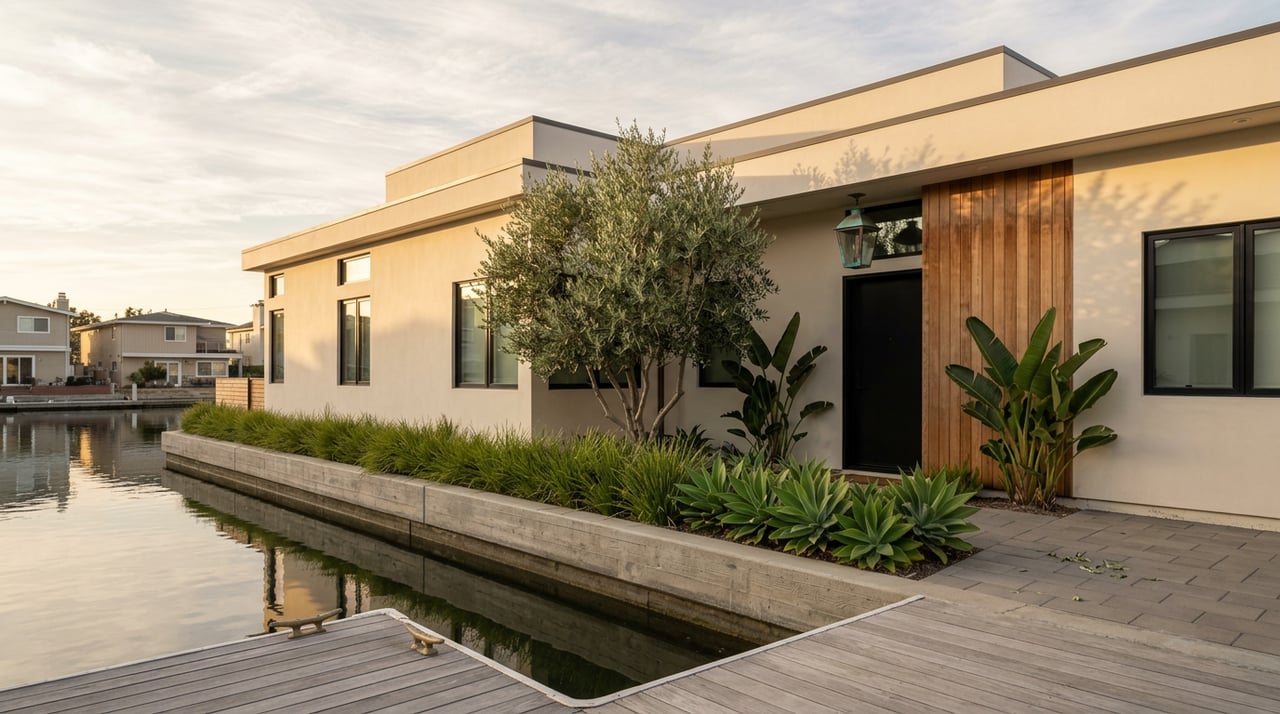
Some Newport Harbor Homes Sell for Half the Price Per Square Foot, and the Deed Explains Why
A buyer touring Newport Harbor waterfront this year will hit a number that does not make sense at first. A bayfront home in Beacon Bay closes at roughly $1,520 a square foot. A few hundred yards away, on Linda Isle or in Bayshores, a comparable bayfront home closes or lists at two to five times that figure. Same harbor. Same boats going by. Same sun setting over the same water.
The gap is not about condition, size, or even location within the harbor. It is about what is actually being sold. In Beacon Bay, the buyer owns the house and signs a lease for the ground it sits on. Everywhere else on this list, the buyer owns both. That single structural difference is doing almost all of the work in the price-per-square-foot math, and it is the part most buyers do not fully price in until they are already deep into escrow.
Beacon Bay is a small, well-kept enclave of 73 homes off Harbor Island Drive, founded in 1927, with a private groomed beach, tennis and pickleball courts, small boat docks, and views across the water to Balboa Island. None of that reads like a discount neighborhood.
What makes it different is the ground underneath it. Beacon Bay sits on tidelands originally granted to the City of Newport Beach by the state in 1919, with the current framework set by what the city calls the Beacon Bay Bill of 1978. Instead of buying the lot, a Beacon Bay buyer signs a new 50-year lease with the city at the time of purchase, priced at roughly 2.5% of the purchase price per year, with annual cost-of-living adjustments built in. The buyer owns the home and everything on it. The land stays with the city.
That arrangement is unusual for single-family residential Newport Beach, but it is not exotic within the city's broader tidelands system. Newport Beach's harbor department administers leases and permits across a range of tideland uses, from marinas to yacht clubs, precisely because a large share of Newport Harbor's waterways are held in public trust rather than privately owned outright.
Here is how three recent Newport Harbor transactions line up:
| Community | Ownership structure | Transaction | Size | Price per square foot |
|---|---|---|---|---|
| Beacon Bay | Leasehold (City of Newport Beach) | 65 Beacon Bay, sold 2026, $2,800,000 | 1,839 sq ft | approximately $1,520 |
| Bayshores | Fee simple | 2668 Bayshore Drive, sold April 2026, $33,500,000 | 6,550 sq ft | approximately $5,115 |
| Linda Isle | Fee simple | 3 Linda Isle, listed 2026, $12,888,000 | 4,083 sq ft | approximately $3,155 |
The Bayshores and Linda Isle homes are larger and sit in different design tiers, so this is not a perfect apples-to-apples comparison on finish level. But the pattern holds across nearly every Beacon Bay sale compared to nearby fee-simple bayfront product: Beacon Bay consistently prices at roughly a third to half the per-square-foot rate of comparable waterfront communities minutes away. That is the market doing real work, pricing in a lease obligation, a financing constraint, and a ceiling on long-term appreciation that fee-simple owners do not carry.
The purchase price is only part of the carrying cost in Beacon Bay. On a $2.8 million home, the land lease alone runs around $70,000 in year one, calculated at 2.5% of the purchase price. Property taxes on top of that run close to 1.3% annually by local estimates, adding roughly $36,000. Combined, that is somewhere near $106,000 a year before the lease's built-in cost-of-living adjustment starts compounding it upward year over year.
That is not a hidden fee. It is disclosed in the lease and known to anyone who has shopped the neighborhood. But it changes the comparison math in a way that a simple price-per-square-foot chart does not show. A fee-simple buyer at $5,000 a square foot is paying more up front and building equity in land that appreciates. A Beacon Bay buyer is paying less up front and then making a permanent, escalating annual payment for the right to keep the house where it sits.
Leasehold property does not finance the same way fee-simple property does. Lenders generally want the remaining term on the ground lease to comfortably outlast the mortgage term, and they price and underwrite leasehold collateral differently than land the borrower will fully own. Because Beacon Bay issues a fresh 50-year lease to each new buyer at the time of sale, a buyer today is not staring down a short remaining term the way an owner might be decades into an old lease elsewhere. That resets some of the risk. It does not eliminate the underwriting friction.
In practice, this means fewer standard mortgage products apply cleanly, appraisers have to value the leasehold interest on its own terms rather than pulling fee-simple comps directly, and buyers in this kind of community skew more heavily toward cash purchases or lenders who already understand ground-lease collateral. None of that is a reason to avoid the neighborhood. It is a reason to have the financing conversation in week one, not during the appraisal contingency period.
The lower price per square foot in Beacon Bay is not a bargain waiting to be discovered. It is compensation for a specific and known set of tradeoffs: a permanent, escalating lease payment instead of one-time land ownership, a narrower financing pool, and a marketability profile that is tied to lease mechanics rather than pure land appreciation. Buyers who understand that going in tend to be very happy in Beacon Bay. It delivers real waterfront living, real community, and a lower entry price into Newport Harbor than almost anywhere else on the water. Buyers who assume the discount is simply free money tend to be surprised at refinance time, at resale, or when they run the twenty-year carrying cost against a fee-simple alternative.
A few things worth confirming before an offer goes in on any leasehold property in this part of Newport Harbor:
Does the 50-year lease term reset every time the home sells? Yes. Each new buyer signs a new 50-year lease with the City of Newport Beach at the time of purchase, which is part of why financing looks more workable for a fresh buyer than it might for someone decades into an existing lease.
Is Beacon Bay the only leasehold community in Newport Beach? No, though the models differ. Bayside Village, a manufactured home community on the west side of the bay, also sits on leased land, but the lease structure, monthly cost, and underlying asset type work very differently there than they do in a single-family leasehold community like Beacon Bay. The two should not be compared directly.
Can you finance a Beacon Bay purchase with a standard 30-year mortgage? It depends on the lender and the specifics of the lease at the time of purchase. Because the community operates on ground leases rather than fee-simple ownership, it is worth confirming financing terms with a lender experienced in this type of collateral before making an offer, rather than assuming a conventional loan will apply the way it would elsewhere in Newport Beach.
The price-per-square-foot gap between Beacon Bay and its fee-simple neighbors is real, and it is not going away. What it means for a specific buyer depends on how long they plan to hold the property, how they plan to finance it, and how they weigh a lower entry price against a permanent lease obligation. If you are comparing a Beacon Bay listing against a fee-simple option elsewhere in the harbor, The Rogina Group can walk through the actual lease terms, the financing paths that apply to your situation, and what the real carrying cost looks like against your budget before you write an offer. Call or text to set up a time.
Stay up to date on the latest real estate trends.

Same building. Same square footage. So why can two Long Beach condos sell for hundreds of thousands of dollars apart?
By Tyler Rogina, Broker Associate | Rogina Group at Compass | September 10, 2026
By Tyler Rogina, Broker Associate | Rogina Group at Compass | September 4, 2026
Rooted in family values and driven by purpose, Rogina Group operates with a philosophy that success means more than numbers. It is about impact, relationships, and building a life you are proud of.
ROGINA GROUP
6460 Pacific Coast Hwy Ste 225 Long Beach, CA 90803 Tyler Rogina | CA DRE# 01925584