Adding an ADU or Rental Unit in Costa Mesa: What Property Owners Should Know
If you own property in Costa Mesa, adding an ADU or rental unit may be one of the most practical ways to create flexibility, increase utility, and strengthen long-term value. In a market where housing demand remains strong and available land is limited, ADUs have become an increasingly popular option for homeowners looking to generate rental income, support multigenerational living, or improve future resale appeal.
The key is understanding what works in Costa Mesa today, what the city allows, and where owners can run into costly surprises. Let’s dive in.
Why ADUs Matter in Costa Mesa
Costa Mesa sits in the middle of one of the most supply-constrained housing markets in Southern California. With proximity to the coast, major employment centers, retail, and higher education, demand for smaller independent living spaces continues to grow.
For property owners, that matters because it creates real long-term demand for additional housing options. An ADU is not just a backyard structure or design upgrade. In Costa Mesa, it can serve several purposes at once:
- Long-term rental income
- Housing for family members
- Guest accommodations
- Flexible work or living space
- Added resale appeal
Like many Orange County cities, Costa Mesa has also seen growing interest in garage conversions, detached backyard units, and interior conversions because many lots already have the infrastructure and layouts that make these projects feasible.
What Counts as an ADU in Costa Mesa?
Under current California law, an ADU can take several forms:
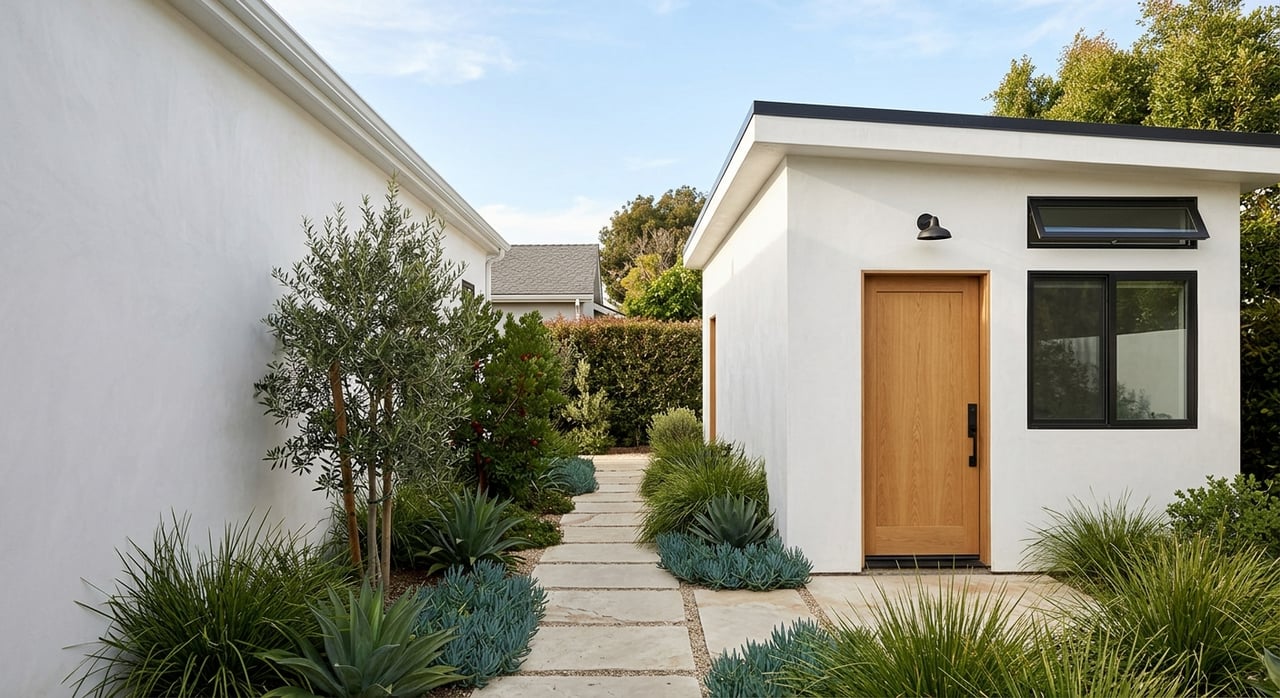
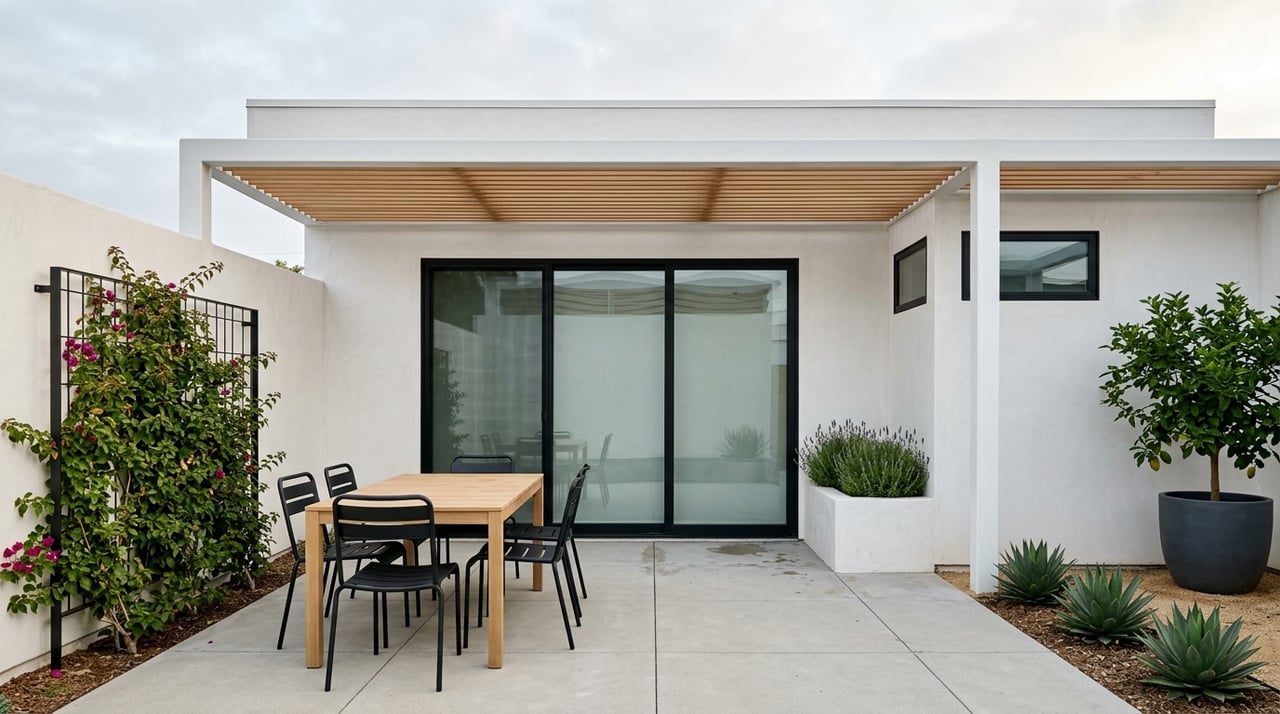
- A detached backyard unit
- An attached addition to the primary residence
- A conversion of existing space such as a garage
- A portion of the existing home converted into a separate unit
You may also hear about a JADU, or junior accessory dwelling unit. A JADU must be located within a single-family residence and is limited to 500 square feet. For some owners, this can be a lower-cost way to create legal living space without building a separate structure.
One important rule to understand is rental duration. California law requires ADUs and JADUs to be rented for terms longer than 30 days, meaning they are intended for long-term housing rather than short-term vacation rentals.
Costa Mesa Permitting: What You Need to Know
Costa Mesa follows California’s state ADU laws while applying local zoning and development standards where permitted. Before starting plans, property owners should verify zoning, lot conditions, and site eligibility with the city’s planning department.
Certain properties may involve additional review requirements. For example:
- Properties near the coast may involve coastal considerations
- Lots with unusual access or utility conditions may require additional planning
- Older neighborhoods may present parking or setback challenges depending on the proposed layout
The ADU approval process is generally ministerial rather than discretionary, meaning qualifying projects are reviewed against objective standards rather than subjective neighborhood approval processes.
According to the California HCD handbook, permitting agencies must determine whether an ADU or JADU application is complete within 15 business days, and qualifying ministerial ADUs are exempt from CEQA review.
That does not mean every project moves instantly, but the process is often more predictable than many owners expect.
Which ADU Type Makes the Most Sense?
The best ADU setup depends on your property layout, budget, and long-term goals.
Here is a simple breakdown of common options:
| ADU Type | Best Fit For | Key Advantage |
|---|---|---|
| Detached ADU | Owners with yard space who want separation | Better privacy and rental independence |
| Attached ADU | Owners expanding from the existing home | Efficient use of existing structure |
| Garage Conversion | Owners looking to reuse existing space | Lower site complexity |
| Interior Conversion | Owners with underutilized square footage | Minimal exterior construction |
| JADU | Single-family owners wanting a smaller addition | Smaller footprint and lower scale |
In many Costa Mesa neighborhoods, garage conversions and detached backyard ADUs are especially popular because they maximize functionality without dramatically altering the primary residence.
What Helps an ADU Pencil Out Financially?
Construction cost matters, but feasibility often matters just as much. Utility upgrades, permitting, lot access, drainage, and site layout can all affect final numbers.
Still, several California ADU rules can significantly improve project economics.
Fee Exemptions
According to the HCD handbook:
- ADUs of 750 square feet or less are exempt from many local impact fees
- JADUs of 500 square feet or less are also exempt from several fee categories
- ADUs and JADUs under 500 square feet are not subject to school impact fees
That means size planning can directly affect project cost.
Parking Flexibility
Many owners assume additional parking will always be required, but California law provides several exemptions.
Parking often cannot be required when:
- The ADU is within one-half mile walking distance of public transit
- The property is in a historic district
- The ADU is created within the existing residence or an accessory structure
That flexibility can make projects viable on smaller Costa Mesa lots where extra parking would otherwise be difficult.
Lot Standards
California law also limits how restrictive local development standards can be for ADUs. In many situations, cities cannot use lot coverage or floor-area-ratio standards to prevent an ADU of at least 800 square feet with four-foot side and rear setbacks.
This gives property owners more flexibility than many expect.
Older Unpermitted Units May Be Worth Revisiting
Some Costa Mesa properties already have converted garages, guest quarters, or back units that were built years ago without full permits.
That can become an issue during:
- Resale
- Refinancing
- Appraisals
- Insurance reviews
In some cases, older unpermitted units may be eligible for legalization through the permitting process depending on how and when they were constructed.
This matters because legal, documented living space is usually easier to market, finance, and appraise than informal bonus space.
A permitted unit with a clean paper trail is generally far more attractive to buyers and lenders.
How ADUs Can Affect Resale Value
Many owners ask whether adding an ADU increases value. In many cases, it can, especially when the unit is:
- Well designed
- Properly permitted
- Functionally useful
- Clearly documented
- Suitable for long-term rental use
The market often rewards flexibility and income potential together.
In coastal Orange County markets like Costa Mesa, buyers increasingly value properties that can support:
- Multigenerational living
- Supplemental rental income
- Guest accommodations
- Home office flexibility
That said, not every ADU adds value equally. Poor layouts, unclear permitting history, or overbuilding a lot can reduce the overall appeal of the property.
Financing, Appraisal, and Tax Considerations
If you are considering an ADU, think beyond construction costs alone.
Financing
Fannie Mae says ADUs may qualify for:
- Standard purchase loans
- Refinance loans
- HomeStyle Renovation financing
- Construction-to-Permanent financing
- Certain programs that allow rental income consideration
Appraisal
Appraisers must evaluate:
- The legality of the ADU
- Marketability
- Comparable properties
- Income potential where applicable
If a unit is noncompliant or unpermitted, that must typically be disclosed.
Property Taxes
New construction can also trigger supplemental property taxes. The California State Board of Equalization says completed improvements are generally considered assessable events tied to the added value of the new construction.
That does not necessarily make an ADU a poor investment, but owners should account for long-term carrying costs when evaluating returns.
A Smart ADU Strategy Starts With the End Goal
Before moving forward, it helps to define exactly what success looks like for your property.
Are you trying to:
- Create long-term rental income?
- Add flexible family living space?
- Improve resale positioning?
- Legalize an existing unit?
- Maximize future buyer appeal?
The strongest ADU projects in Costa Mesa usually come from matching the project scope to the property itself and the owner’s long-term plans.
Sometimes a smaller, efficient ADU creates better returns than a larger, more expensive build. In other cases, legalizing existing space may create more value than starting from scratch.
The right decision is not just about what you can build. It is about what will be functional, compliant, marketable, and worthwhile for your specific property.
When you want a practical strategy for your lot, timeline, and long-term goals, connect with Tyler Rogina to map out the smartest next step.
FAQs
What is the difference between an ADU and a JADU in Costa Mesa?
An ADU can be detached, attached, or created from converted space, while a JADU must be located inside a single-family home and is limited to 500 square feet.
Can you use an ADU in Costa Mesa as a short-term rental?
No. California law requires ADUs and JADUs to be rented for periods longer than 30 days.
Do Costa Mesa ADUs require discretionary approval?
Most qualifying ADUs are reviewed ministerially using objective standards rather than discretionary review processes.
Are garage conversions allowed as ADUs in Costa Mesa?
Yes. Garage conversions are one of the most common ADU types and are often allowed when they meet current building and safety standards.
Are there fee savings for smaller ADUs?
Yes. California rules exempt many ADUs under 750 square feet from local impact fees, and units under 500 square feet may also avoid school impact fees.
Can an older unpermitted unit be legalized?
Possibly. Some older unpermitted units may qualify for legalization depending on construction history and current compliance standards.
Does adding an ADU increase property taxes?
It can. New construction generally creates an assessable event tied to the value of the improvement.
Does a permitted ADU help resale value in Costa Mesa?
In many cases, yes. Buyers often place higher value on properties with legal, functional, income-producing living space.